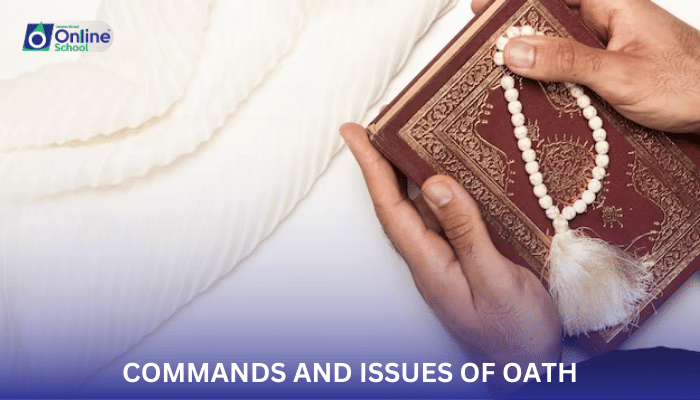
Oath is called Yamen in the Quran and Hadith, the plural of Yamen is Iman. In the terminological sense, a solemn determination by a Muslim and assuring any other person in the name of Allah is called Yamen. The words "Yamen" and "Oath" are also used for swearing. The protection of oath means that at first place, one should not swear or take oath because it is the greatest quality of a Muslim that he never tells a lie but always speaks the truth and a truthful person maintains a standard of truthfulness at social level and people believe in his words. But, if the custom of swearing on petty things become common, it will cause people to waste their time, distrust each other and create an atmosphere of mistrust which is not good. It is against fair dealings and socializing. The commandments regarding oaths are described in the Holy Quran as follows:
لا يُؤَاخِذْ كُمُ اللهُ بِاللغُوفِي أَيْمَانِكُمْ وَلَكِن يُؤَاخِذُ كُمْ بِمَا عَقَّدْتُمُ الْأَيْمَانَ فَكَفَّارَتْ إِطْعَامُ عَشَرَةِ
مَسْكِيْنَ مِنْ أَوْسَطِ مَا تُطْعِمُونَ أَهْلِيْكُمْ أَوْ كِسْوَتُهُمْ أَوْ تَحْرِيرُ رَقَبَةٍ فَمَنْ لَّمْ يَجِدْ فَصِيَامُ ثَلَثَةِ أَيَّامٍ
ذَلِكَ كَفَّارَةُ أَيْمَانِكُمْ إِذَا حَلَفْتُمْ وَاحْفَظُوا أَيْمَانَكُمْ كَذلِكَ يُبَيِّنُ اللَّهُ لَكُمْ آيَتِهِ لَعَلَّكُمْ تَشْكُرُونَ
Translation:
"Allah does not hold you accountable for your laghw (ineffectual) oaths, but He does hold you accountable for the oath with which you have bound yourself. Its expiation is to feed ten poor persons at an average of what you feed your family with, or to clothe them, or to free a slave. However, if someone cannot afford, he has to fast for three days. That is expiation for the oaths that you have sworn. Take care of your oaths. That is how Allah makes His signs clear to you, so that you may be grateful." (Surah Al-Maida: 89) The second important thing about swearing(taking oath) is that it should only be in the name of Allah. Apart from this, there is no other concept of swearing in Shariah in the name of parents, the Holy Prophet (s) or any other sacred thing.
The Holy Prophet said:
"Undoubtedly, Allah forbids you to swear in the name of your ancestors." (Sahih Muslim: 4254)
The companions of the Holy Prophet never took oath other than in the name of Allah after listening to this hadith as at another instance, the Messenger of Allah said :
"Whoever swears by other than Allah, he has committed disbelief or shirk." (Jami at-Tirmidhi: 1535)
The third thing regarding the oath is that if a person takes an oath to refrain from a lawful act that he will not do that act then such an oath should be given up and expiation should be paid. The Holy Prophet says that the person who took oath about any task but he is of the opinion that the welfare for others and for himself lies in the opposite decision, then he should go for that decision and pay expiation for his oath. For example, if a person swears by Allah that he will not talk to such and such a friend or parent or teacher, then he should break the oath and pay expiation. The type of expiation is, if he wants, to give food to ten poor people, or to give clothes to ten poor or needy, free a slave who is innocent or if he is not able to pay expiation in any of these forms then he must fast for three days. The fourth point regarding the oath is that the kind of expiation that is to be paid, that is to take an oath regarding something in the future, it is called Yamen Munaqida'. Taking a false oath on a past incident is called Yamen Ghamoos', there is no expiation for this oath, but Islam has disliked this oath, it is a great sin. In daily conversation, if you take the correct oath according to your opinion, but the event does not happen like this, it is called 'Yamen Laghav' (False oath). Allah Almighty has waived off such oath. False swearing is a great sin and deceiving of humanity, and Allah will not show mercy to the one who swears falsely on the Day of Judgment. False oaths cause individual as well as collective destruction. We should also pray and strive practically to avoid them.
